
Swissmedic pharmacovigilance guidance: RPV and deputy requirements

Swissmedic is Switzerland’s regulator for medicines and medical devices. It authorizes medicines and monitors their safety once they are on the market.
Its pharmacovigilance guidance, valid from 1 September 2026, focuses on the people responsible for medicine safety within a company. Pharmacovigilance (PV) means monitoring the safety of medicines and responding to possible risks.
The guidance sets out expectations for the Responsible Person for Pharmacovigilance (RPV), who oversees the company’s Swiss PV activities, and for the deputy who must be able to take over when needed.
Chanbasha Shaik, Head of Pharmacovigilance at Voisin Consulting Life Sciences (VCLS), explains why companies with established systems should still look closely at their Swiss arrangements:
“Having a strong global PV system does not automatically mean that your Swiss PV arrangements are fully compliant.”
Who does the Swissmedic guidance apply to?
The guidance applies to marketing authorization holders, meaning the companies that hold approval to market a medicine, and manufacturers of medicines for human use. Chanbasha’s advice is particularly relevant to companies entering Switzerland or using an external PV provider.
The RPV role predates this guidance. The document clarifies expectations on qualifications, appointment timing, deputy arrangements and provider oversight. Chanbasha recommends starting with three practical checks.
1. Make sure the RPV and deputy can do the job
Start with the qualifications and availability of the people appointed. Both must have theoretical and practical PV knowledge, understand Swiss medicine-safety legislation and be fluent in at least one official Swiss language.
The company also needs a reliable process for translating PV documents and communications, with checks on translation quality.
Consider what happens when the RPV is absent. The deputy must be able to take over fully, without a break in PV activities. That means access to the relevant records, a documented handover and an understanding of any outstanding reports or requests from Swissmedic.
The people in both roles need enough time and support to carry out their responsibilities. As Chanbasha explains:
“The RPV should not be treated as a regulatory name on a document. It is an active responsibility, and the company needs to make sure the role is properly resourced and supported from the beginning.”
When should the RPV and deputy be appointed?
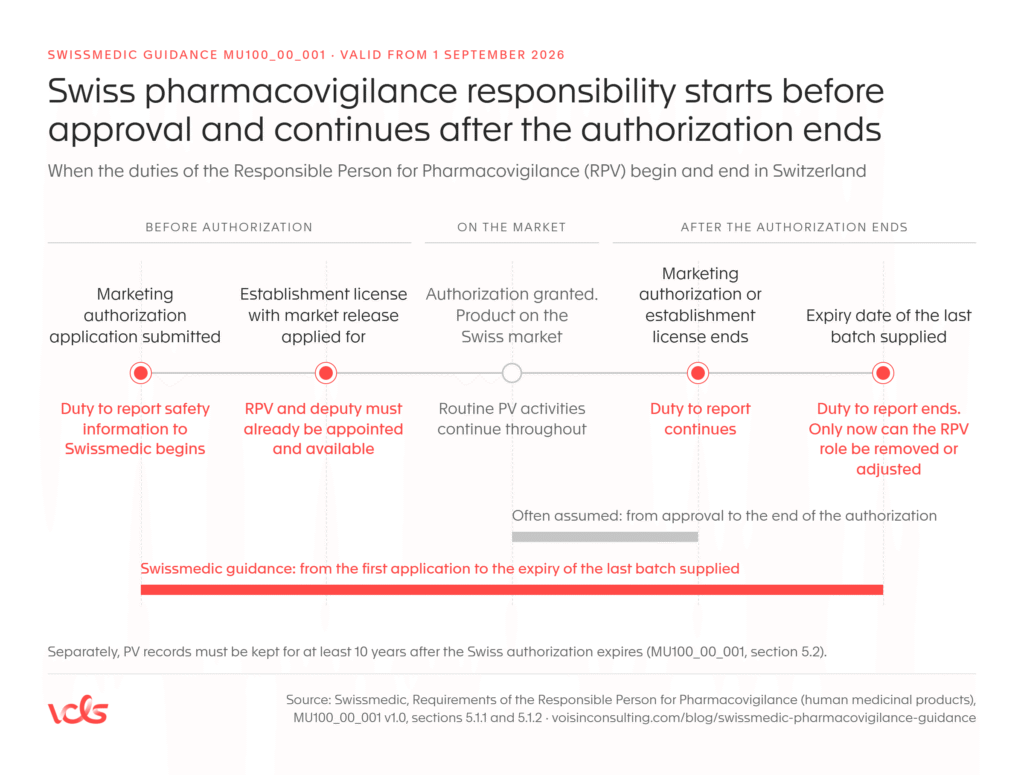
Both must be appointed and available when an application for an establishment license with market release is submitted. Market release is the decision to place a batch of medicines on the Swiss market.
Separately, the obligation to report safety issues begins when a marketing authorization application is submitted. Plan the appointments and safety-reporting process before the relevant applications are submitted.
2. Follow a Swiss side-effect report from start to finish
Take a report of a suspected side effect and follow it from the moment it reaches your organization.
Ask the people involved to show you who assesses the information, who decides whether it needs to be reported to Swissmedic and who makes that submission. You should also be able to see how deadlines are tracked, follow-up is handled and decisions are recorded.
In Chanbasha’s experience, some companies with global PV agreements and external providers still have difficulty saying who is responsible for a Swiss safety report or for answering a Swissmedic query.
Walking through an example with staff can reveal handovers that are difficult to follow across teams or providers. Where a responsibility is unclear, agree who will take it on and update the written procedure.
Expand the exercise to a safety signal: information suggesting a new or changed risk that needs investigation. It should also cover requests from Swissmedic and risk-minimization measures, which are actions intended to reduce the risks associated with a medicine.
3. Check how external PV providers are supervised
The PV agreement should make clear who does each task and how information moves between the company and the provider. Your records should then show whether the work is being done as agreed and what happens when something goes wrong.
Swissmedic identifies six elements of provider oversight:
- Regular performance monitoring, including the quality and timeliness of reporting.
- Audits with documented findings.
- Quality reviews.
- Clear routes for communication and for raising problems that need action.
- Checks on provider staff qualifications, including after staff changes.
- Verification that all contracted activities are completed.
On outsourcing, Chanbasha says:
“You can outsource the activity, but you cannot outsource the accountability.”
The marketing authorization holder remains responsible for PV when a provider carries out the work. It should be able to show the checks it has made, any concerns it has raised and how those concerns were resolved.
Common questions about Swiss pharmacovigilance
Does the RPV have to live in Switzerland?
No. The RPV and deputy do not have to live in Switzerland or be directly employed by the company. They must still meet the qualification requirements, including fluency in at least one official Swiss language.
Does PV reporting stop when a Swiss authorization ends?
No. The obligation to notify Swissmedic of safety issues continues until the expiry date of the last batch supplied, even if the marketing authorization or establishment license is no longer valid. Companies need to plan who will fulfil that obligation and, separately, how long PV records must be kept.
Does an EU PV system automatically meet Swiss requirements?
Not automatically. An EU or global system can provide the foundation for Swiss PV activities. It still needs to cover Swiss responsibilities, including RPV and deputy arrangements, reporting, language requirements, local quality processes and provider oversight.
How VCLS can help with Swiss pharmacovigilance
VCLS can review your existing PV arrangements to identify where Swiss requirements are covered and where changes are needed. This Swiss PV readiness assessment helps you decide which gaps to address first.
Support includes Swiss RPV and deputy services, PV quality systems and written procedures, agreements with external providers, provider oversight and preparation for inspections.
Find out more about VCLS pharmacovigilance services.
Sources
About Swissmedic: Swiss Agency for Therapeutic Products.
Swissmedic: Requirements of the Responsible Person for Pharmacovigilance (human medicinal products), MU100_00_001, version 1.0, valid from 1 September 2026. Relevant sections: 3–4, 5.1 and 5.3.
Swissmedic: guidance on establishment licence applications, section 4, for the explanation of market release.
