
Could the EU SoHO Regulation affect your development pathway?

Five questions for medicinal product, ATMP, medical device and microbiota-based developers working with human-derived materials.
A product may be regulated as a medicinal product, advanced therapy medicinal product or medical device, yet still be affected by the EU Substances of Human Origin Regulation earlier in its development and supply chain.
Regulation (EU) 2024/1938 establishes updated quality and safety standards for substances of human origin intended for human application. Its scope includes material collected from the human body, whether it contains cells or not and whether those cells are living or non-living. Examples include blood, tissues, cells, reproductive material, donated human milk and intestinal microbiota.
The Regulation entered into force in August 2024. Its main provisions will apply from 7 August 2027, with an additional year for certain provisions and transitional arrangements. Until then, the existing EU Blood and Tissues and Cells Directives, together with the national legislation implementing them, continue to apply.
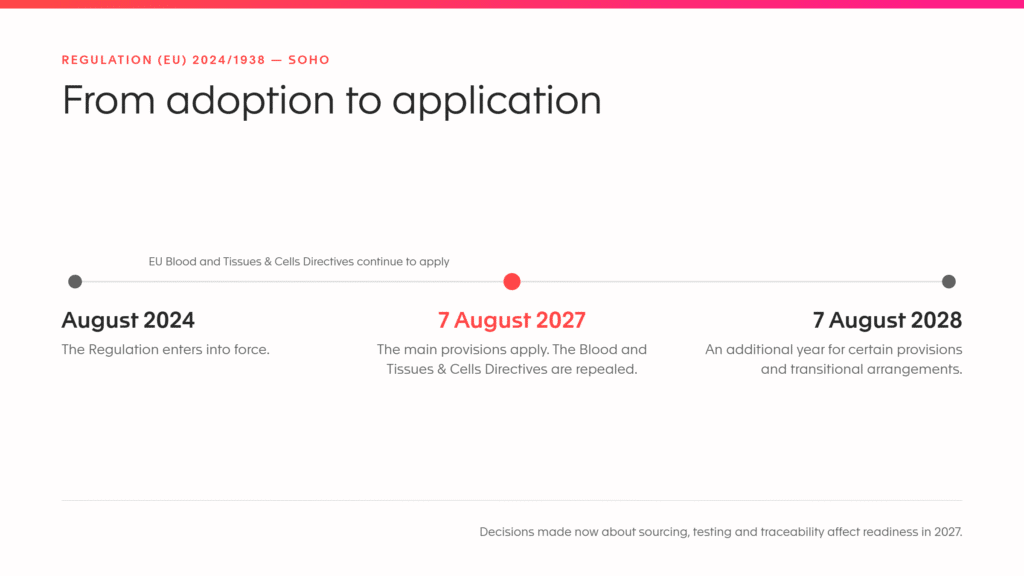
For companies developing products involving human-derived materials, 2027 should not be viewed simply as a future compliance date. Decisions made now about sourcing, donor assessment, testing, processing, traceability, storage and supply could affect readiness for the new framework.
Key takeaways
- Classification as a medicinal product, ATMP or medical device does not necessarily remove upstream SoHO considerations.
- Specified SoHO requirements may apply to activities involving human-derived material before it reaches the product manufacturer.
- Scope depends on more than the finished product. The material, intended use, activities performed and organizations involved all matter.
- The framework expressly includes human milk and intestinal microbiota.
- Borderline cases may require coordination between SoHO and medicinal product, ATMP or device authorities.
- Early assessment can identify potential implications for sourcing, CMC, quality systems, traceability, contracting and regulatory strategy.
Why developers need to look upstream
The regulatory status of the finished product is only one part of the analysis.
Human-derived material may be collected for the manufacture of:
- a medicinal product;
- an ATMP;
- an investigational medicinal product; or
- a medical device.
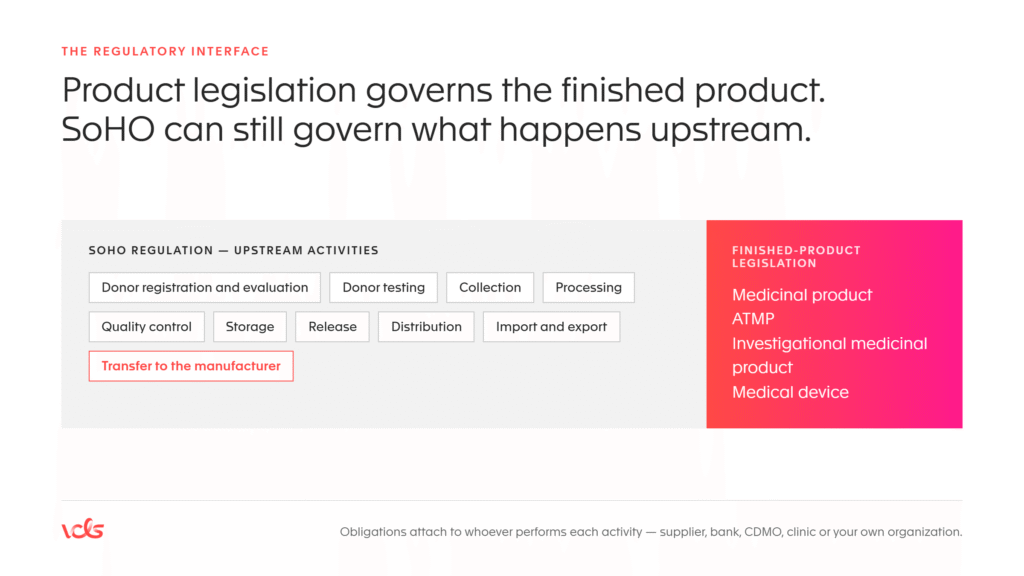
In these cases, the finished product may be governed by its applicable sector-specific legislation. However, specified SoHO requirements can continue to apply to activities involving the starting or source material before, and in some circumstances up to, its distribution to the manufacturer.
These upstream activities can include:
- donor registration and evaluation;
- donor testing;
- collection;
- storage;
- release;
- distribution; and
- import and export.
This creates an important regulatory interface. A developer may be responsible for the finished product strategy without directly carrying out every SoHO activity. Responsibility for to ensure compliance may require the manufacturer to maintain oversight of activities performed by a supplier, hospital, clinic, importer, distributor, contract development and manufacturing organization, SoHO entity or SoHO establishment.
The practical question is therefore not whether this is a SoHO or a medicinal product – but rather: where does the SoHO framework apply across the pathway before the finished-product legislation takes over?
What changes under the new framework?
The Regulation replaces the existing EU blood, tissue and cell framework with a broader, directly applicable system. It extends the framework to additional substances, including donated human milk and intestinal microbiota, and covers activities from donor registration and testing through processing, distribution, human application and clinical-outcome monitoring.
The framework is intended to strengthen protection for:
- SoHO donors;
- recipients;
- offspring born from medically assisted reproduction; and
- the continuity and resilience of SoHO supply.
For product developers, the implications can extend beyond regulatory classification. They may affect the controls, evidence and agreements supporting the material from donation or collection through to manufacture.
Five screening questions for developers
The following questions provide an initial screen. They are not a substitute for a product- and supply-chain-specific regulatory assessment.
Does the product or manufacturing process involve material collected from the human body?
The assessment should cover the entire development and manufacturing process, not only the active substance in the finished product.
Potentially relevant materials include:
- blood and blood components;
- cells and tissues;
- reproductive cells and tissues;
- donated or banked human milk;
- intestinal microbiota;
- blood preparations not used for transfusion; and
- preparations produced by processing substances collected from the human body.
Solid organs intended for transplantation remain under their dedicated EU framework. Breast milk used exclusively to feed the donor’s own child is also treated differently where no processing is carried out by a SoHO entity.
If no human-derived material enters the product or manufacturing process, the SoHO Regulation is unlikely to apply. That conclusion should nevertheless consider the complete supply chain, including materials used before final manufacture.
What is the material intended for?
The intended use helps determine which regulatory framework governs the finished output and where SoHO requirements may continue to apply.
The material may be intended for:
- direct human application, including infusion, transfusion, transplantation, implantation, assisted reproduction or ingestion;
- processing and release as a SoHO preparation; or
- manufacture of a medicinal product, ATMP, investigational medicinal product or medical device.
The answer may not always be straightforward. Cell-based products, for example, may be regulated as ATMPs and/or as SoHO preparations depending on their characteristics, degree of manipulation, intended function and use. The same source material can therefore lead to different regulatory pathways according to how it is processed and what it is intended to do.
Which SoHO activities occur in the supply chain?
Developers should map the relevant activities from the earliest point in the pathway. Questions to consider include:
- Who identifies, registers and evaluates donors?
- Who performs donor testing?
- Where is the material collected?
- Is the material processed or combined with other materials?
- Where is it stored?
- Who performs quality control and release?
- Is it imported into or exported from the EU?
- Who distributes it to the manufacturer?
- Is traceability maintained across organizational boundaries?
- Who is responsible for vigilance and reporting?
This mapping can reveal obligations that may not be visible when the assessment begins with the finished product alone.
Which organizations perform those activities?
The developer may not be the organization carrying out the regulated activity.
The supply chain could involve:
- a SoHO entity;
- a SoHO establishment;
- a hospital or clinic;
- an importer or distributor;
- a CDMO or service provider;
- a tissue, cell, blood, milk or microbiota bank; or
- the product developer’s own organization.
Every SoHO establishment is a SoHO entity, but not every SoHO entity is a SoHO establishment. The relevant status depends on the activities performed.
A contractual allocation of responsibilities does not, by itself, determine which organization carries the regulatory obligation. Supplier qualification, technical agreements and governance arrangements should reflect the activities and responsibilities across the pathway.
Is the boundary between regulatory frameworks clear?
Some products and activities will sit close to the boundary between:
- the SoHO Regulation;
- medicinal product legislation;
- the ATMP Regulation;
- medical device legislation; and
- the framework for organs intended for transplantation.
The SoHO Regulation recognizes that uncertainty may arise in borderline cases. Where the regulatory status is unclear, consultation and coordination may be needed between the relevant SoHO and sector-specific authorities.
This makes early classification important, but classification should not be treated as a one-time decision. The analysis may need to be revisited as the manufacturing process, product characteristics or intended use develop.
What could be affected if SoHO is considered too late?
The consequences of a late assessment will depend on the material, activities, organizations and product pathway. Potential areas of impact include the following.
- Sourcing and supplier strategy
A material supplier may need to operate within the SoHO framework or hold an appropriate authorization. If supplier status, donor controls or collection arrangements are unclear, the sourcing model may need to be revisited. - Donor protection, consent and testing
Requirements relating to donor evaluation, testing and protection can affect whether material has been collected and documented in a way that supports its intended use. - Traceability and coding
Developers may need continuity of traceability across multiple organizations and regulatory frameworks, including the transfer of appropriate information to the manufacturer. - CMC and comparability
Changes to source material, collection models, processing controls or suppliers can affect the CMC strategy. Depending on the product and development stage, later changes may also create comparability or evidence-generation questions. - Quality systems and agreements
Responsibilities for collection, testing, processing, storage, release, distribution, vigilance and reporting should be clearly understood and reflected in quality arrangements. - Development timelines
If a classification or supply-chain issue is identified only during clinical-trial or marketing-authorization preparation, resolving it may require additional documentation, supplier work, authority engagement or process changes.
The appropriate response is not to assume that SoHO creates a barrier. It is to determine early where the framework enters the pathway and design the development and supply strategy accordingly.
Download the EU SoHO Regulation Checker
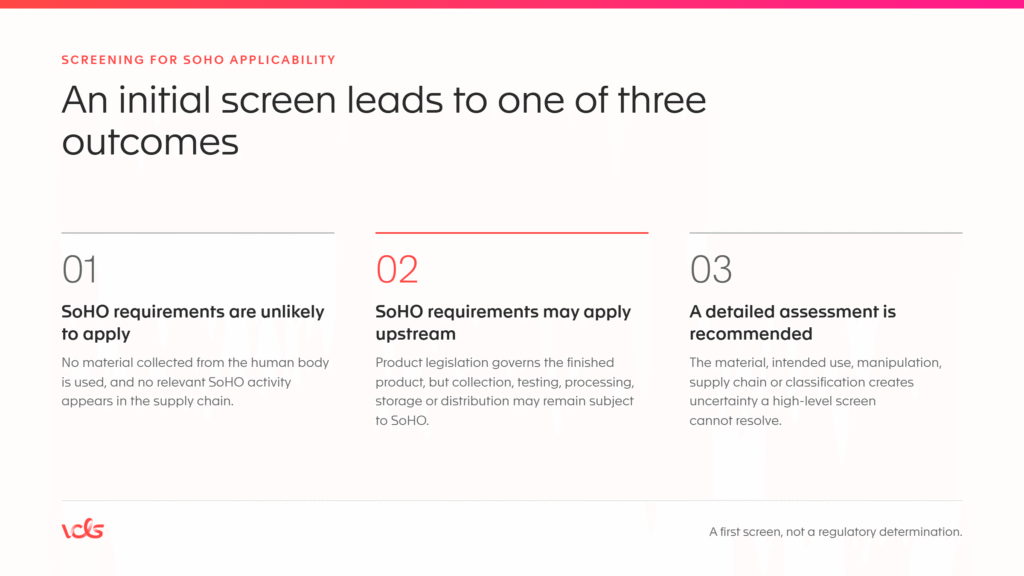
Our EU SoHO Regulation Checker brings the five screening questions together in a one-page visual:
- Does the product or process involve material collected from the human body?
- What is the material intended for?
- Which SoHO activities occur in the supply chain?
- Who performs them?
- Is the regulatory interface uncertain?
The infographic (download here) is intended as a first screen for medicinal product, ATMP, medical device and microbiota-based developers. It does not provide a definitive classification or legal interpretation:
Frequently asked questions (FAQs)
- Does the SoHO Regulation apply to medicinal products and ATMPs?
The finished product may be regulated under medicinal product or ATMP legislation. However, specified SoHO requirements can still apply to upstream activities involving the human-derived starting or source material, including donor registration and evaluation, donor testing, collection storage, release, import and export. - When will the EU SoHO Regulation apply?
The Regulation entered into force in August 2024. Its main requirements will apply from 7 August 2027, with an additional year for certain provisions and transitional arrangements. - Does the Regulation cover human microbiota?
The framework includes intestinal microbiota within its broad scope. The implications for a particular microbiota-based product will depend on the material, activities, processing, intended use and final product classification. - Is human breast milk included?
Donated or banked human milk can fall within the framework. Breast milk used exclusively to feed the donor’s own child is treated differently where it has not been processed by a SoHO entity. - Does medicinal product classification remove SoHO obligations?
Not necessarily. Product classification determines the legislation governing the finished product, but specified SoHO requirements may continue to apply to upstream activities involving the human-derived material. - Can the infographic determine whether the Regulation applies?
No. The infographic provides an initial screen to identify where a more detailed assessment may be needed. It does not replace product-specific analysis, competent-authority guidance or legal interpretation. - Working with human-derived materials?
VCLS supports biotech, pharmaceutical, medical device and microbiota-based product developers in assessing where SoHO requirements may enter the development pathway and how they interact with medicinal product, ATMP and medical device legislation.
VCLS teams can support:
- regulatory classification and applicability assessment;
- Readiness assessment and transition planning;
- supply-chain and activity mapping;
- CMC and starting-material strategy;
- assessment of regulatory interfaces;
- authority-interaction planning;
- quality, traceability and development implications; and
- integrated regulatory and product development strategy.
Discuss your development program with VCLS
VCLS (Voisin Consulting Life Sciences) is a specialist life sciences product development partner helping biotech, pharmaceutical and medical device innovators advance complex products through regulated development and toward patient access.
This article and the accompanying infographic provide general regulatory information and an initial screening framework. They do not constitute a definitive product classification, legal advice or a substitute for product-specific regulatory assessment.
Sources
- European Union, Regulation (EU) 2024/1938 on standards of quality and safety for substances of human origin intended for human application: https://eur-lex.europa.eu/eli/reg/2024/1938/oj/eng
- EUR-Lex, Summary of Regulation (EU) 2024/1938: https://eur-lex.europa.eu/legal-content/EN/LSU/?uri=CELEX:32024R1938
- European Blood Alliance, SoHO Regulation text: https://europeanbloodalliance.eu/resources/soho-regulation-text/
- Organización Nacional de Trasplantes, The SoHO Regulation: all you need to know to get started: https://www.ont.es/wp-content/uploads/2026/04/Information-paper-The-SOHO-Regulation-all-you-need-to-know-to-get-started.pdf