
China’s IP Protection Reform on Regulatory & Market Exclusivity

In a previous blog (China’s IP Protection Reform on Patent Term Extension (PTE): Impact on Drug Development & Regulatory Strategies), we examined the patent-side protection available under Article 42 of the amended Chinese Patent Law. Patent Term Extension (PTE) may compensate for regulatory review and approval time, while Patent Term Adjustment (PTA) addresses certain patent-grant delays. For sponsors, these patent-based mechanisms should be considered alongside China’s evolving regulatory exclusivity framework, rather than treated as substitutes for it.
Scroll down for our full, ungated infographic.
Patents inevitably expire, and some development outputs may not support enforceable new patent claims. Regulatory exclusivity can therefore provide an additional, non-patent layer of protection. In China, the framework now involves three related but distinct concepts:
- PTE/PTA – mechanisms that may extend or adjust patent protection;
- Regulatory Data Protection (RDP) – protection against reliance on certain undisclosed data submitted to support approval;
- Market Exclusivity (ME) – restrictions on approval of certain competing products for a defined period where applicable.
Although China first introduced protection for undisclosed drug trial data in the 2002 version of the Regulations for the Implementation of the Drug Administration Law, implementation remained limited for many years because detailed procedures and product-category rules were not fully developed. The 2026 measures provide a more operational framework and make RDP a more practical consideration in China development and launch planning.
China’s New RDP and ME Framework
RDP and ME may both affect follow-on entry, but they operate differently. RDP focuses on whether a later applicant may rely on protected data submitted by the originator, whereas ME can limit approval of competing products within a defined scope. This distinction is important because RDP does not necessarily prevent approval where an applicant independently generates the required data.
- RDP – Regulations for the Implementation of the Drug Administration Law (2026 Revision, State Council Order No. 828); Article 22 provides for protection of undisclosed data independently obtained by manufacturers or distributors for drugs containing new chemical components. The RDP period may be up to 6 years. Implementation Measures for the Regulatory Data Protection (NMPA Announcement No. 47 of 2026): It clearly states the RDP period for every type of drug and the implementation procedures.
- ME – China has also introduced or signalled market exclusivity incentives for selected product categories, including up to 7 years for eligible orphan drugs, up to 2 years for eligible paediatric drugs, and 1 year in connection with a successful patent challenge. Detailed implementation requirements may vary by product category and should be assessed against the applicable rules and subsequent guidance.
How China’s Measures Compare with the US and EU
The table below provides a high-level comparison of selected regulatory exclusivity and market exclusivity provisions in the US, EU and China. The comparison is intended to support strategic orientation rather than replace product-specific legal or regulatory analysis.
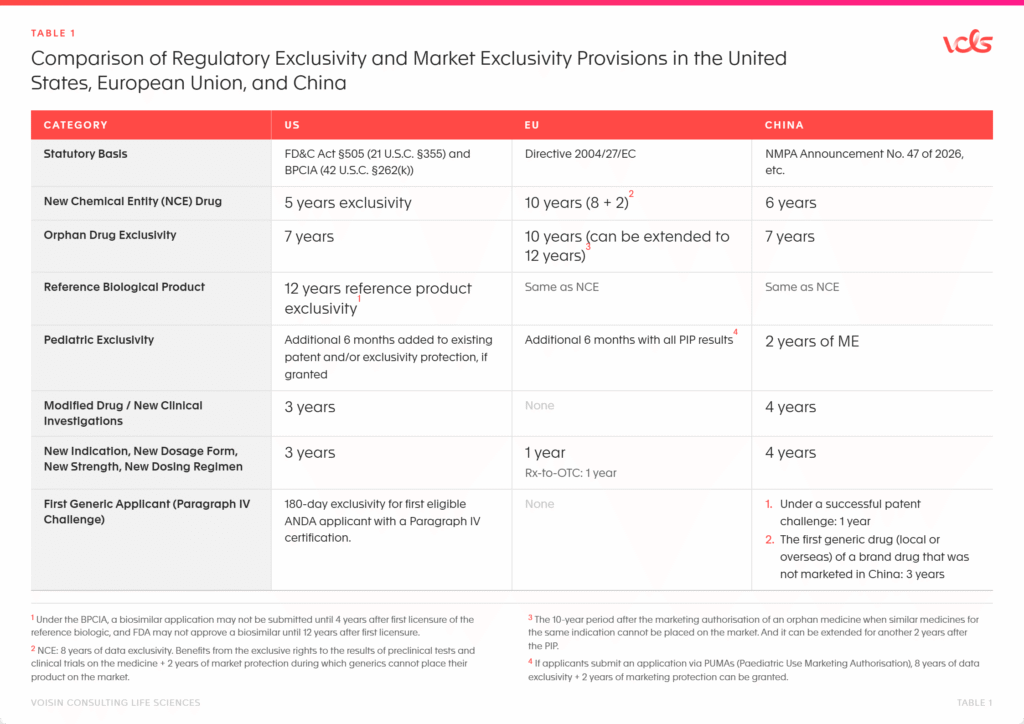
For sponsors considering China in global development or launch planning, two practical implications of the 2026 measures are particularly relevant:
- Firstly, China has created a targeted incentive for the first approved generic applicant where the originator product has been marketed overseas but not in China. In relevant cases, protection may be available for necessary clinical data generated to support approval in China. This creates an additional consideration for sponsors evaluating whether and how quickly to bring overseas-approved products into the Chinese market.
- Secondly, a pivotal revision to the RDP start date for imported drugs. The 20254 draft measures proposed calculating RDP from the earlier overseas MA date, a design clearly intended to incentivize integrating China into global drug development by preserving the effective protection window. Under that approach, however, the statutory 6‑year term would have been reduced by the time gap between overseas approval and domestic acceptance, meaning only a synchronized global filing could secure the full RDP period. In effect, the draft imposed a de facto “synchronization penalty” on late entrants. But the finalized 2026 Measures replace this model with a full 6-year RDP from the NMPA approval date, regardless of when the product was first authorized abroad. While the revised rule no longer compels simultaneous global launches, it preserves the core policy objective of encouraging drugs already approved abroad – but not yet available in China – to enter the Chinese market and benefit local patients.
Summary
The operationalization of RDP, together with emerging ME incentives, marks an important step in the evolution of China’s pharmaceutical IP and regulatory framework. For global sponsors, the practical value lies less in any single protection period and more in how these mechanisms interact with patent strategy, clinical development planning, filing sequence and China market-entry timing.
The wider policy direction is also clear: China continues to refine pathways intended to support innovation, accelerate access for eligible products and make participation in global development more predictable.
Sponsors should therefore assess RDP, ME, PTE and PTA together as part of an integrated China strategy, with product-specific analysis of eligibility, evidence requirements, timing and competitive risk. Early planning will be particularly important for companies seeking to align China with global development while preserving future flexibility.